


Department News
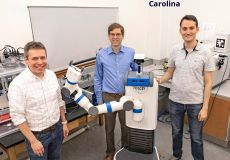
The Carolina Materials Consortium is pleased to announce it has published the first issue of Carolina Matters, a new magazine showcasing the breadth and ambition of materials science research at UNC-Chapel Hill.
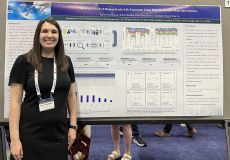
A recent study in Chemical Research in Toxicology looks at environmental health by mapping the wide range of chemicals that children are exposed to in everyday life.
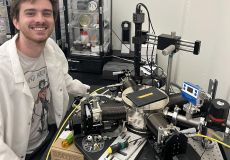
In a step toward smaller and more controllable quantum devices, researchers at UNC-Chapel Hill have found a new way to generate and control tiny sound waves using superconducting materials.

Researchers in Professor Matthew Redinbo’s Lab in the Department of Chemistry at UNC-Chapel Hill, along with collaborators in the School of Medicine, have discovered that differences in gut bacteria, collectively known as the microbiome, may help explain why some people experience more gut toxicity than others.
Research
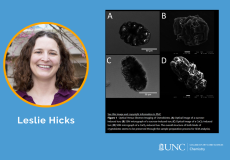
Herein, an approach for discriminating between tardigrade morphological states is developed and utilized to compare sucrose- and CaCl2-induced tuns, using the model species Hypsibius exemplaris.
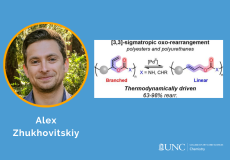
Herein, we disclose a backbone rearrangement approach to tune the short-chain branching of polymers.
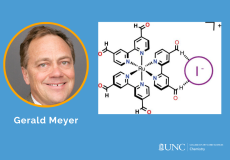
A new homoleptic Ru polypyridyl complex bearing two aldehyde groups on each bipyridine ligand, [Ru(dab)3](PF6)2, where dab is 4,4′-dicarbaldehyde-2,2′-bipyridine, was synthesized, characterized, and utilized for iodide photo-oxidation studies.
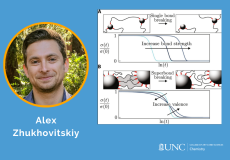
Here, we propose a model where the relaxation of polymer gels in the dilute regime originates from elementary events in which the bonds connecting two neighboring cross-linkers all disconnect.
Our Faculty
Faculty in the Department of Chemistry at the University of North Carolina help define solutions to the pressing scientific problems of the day. A significant and key component of our department’s strategic plan is to cultivate the next generation of scientific leadership. Faculty, from our assistant professors to our most senior and distinguished colleagues, are international leaders in their subfields, garnering local, national, and international recognition and accolades commensurate with their excellence in research and teaching.
Our Graduate Students
Our graduate students form the next generation of scientific leaders. As a department, we seek to recruit and mentor a diverse cohort of students dedicated to excellence in the classroom and research laboratory. The creativity, drive, collegiality, and accomplishments of our graduate students in tackling difficult scientific problems are significant reasons why UNC is an international leader in chemical research.